

Cheat Sheet: Agentic Intent Based Access Control
A key capability for handling agentic risk analysis and response at runtime

The What
Let us take a step back before focusing our attention on agentic identity. If we think merely in terms of humans and existing intent management capabilities, intent management relates to the analysing and predicting user behaviour through classic behavioural science and digital signals.
The core concept involves understanding what a user is likely to do - mainly in terms of buying signals or decision-making - taking a look at either their physical body language, or more latterly by analysing their digital body language.
This includes thousands of behavioural micro-expressions captured while a user interacts with a digital interface - perhaps an advert, digital store front or filling out an online application. From there marketing technology (martech) scoring functions can be used to identify if a user is “mad, sad or glad” when interacting with a piece of digital content.
This “intent data” can be used to better predict and react to user signals in real time - either by showcasing different products or adverts.
Of course these concepts can also be applied to information security - and in the digital setting trying to “spy the lie” as it pertains to access management such as on-boarding or authorization decision making and enforcement.
Specifically from an identity security perspective, this connects to broader themes around runtime attribution - namely understanding who is doing what and why. Digital attribution can leverage the ability for biometric lineage and tying back an event to a specific identity. This not only helps with traceability but also contributes to risk analysis and composite understanding regarding motive and opportunity with respect to malicious behaviour. Of course not all identities will have biometric attributes - aka non-human identities or agentic-identities so we need to consider how to proxy this.
But returning back to intent, we need to consider where it sits in the overall identity security space and then specifically within agentic-identity security.
Can we therefore start to think of a simple and broader identity security question that intent management can help solve?
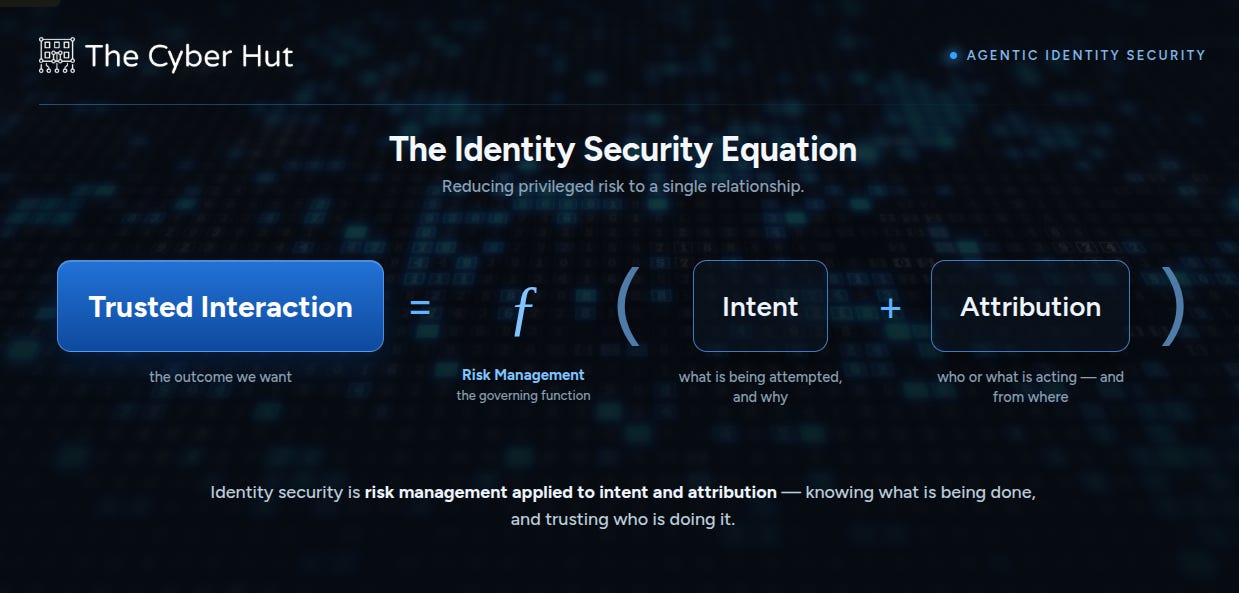
The word “trusted” here is important (as opposed to trustworthy). Trusted is more likely aligned with a volatile action and changeable decision. Trustworthy is more likely to an inherent repeatably proven trait. For example boot attestation may result in a measurably “trustworthy” operating system. A process on top of that is “trusted” after obtaining specific credentials.
Let us move back to agentic-identity security. Two other ingredients are needed for our “Trusted Interaction” story: authorization and guardrails. (N.B Authorization is such a large topic it will be treated in a separate cheat sheet).
Authorization will require several well known building blocks: policy decision points, policy enforcement points and of course a policy to link those together. In the framework above, authorization is determining whether an agent should have “read” or “read and write” access based on rules, context, the task being completed and so on.
The intent aspect is going to analyse whether the agent is using that “read” access to read a document to complete legitimate work, or read a document to send to a nation state for espionage purposes.
Guardrails are merely there to help with prompt engineering, ingress and egress filtering and helping to define the outer bounds of expected behaviour.
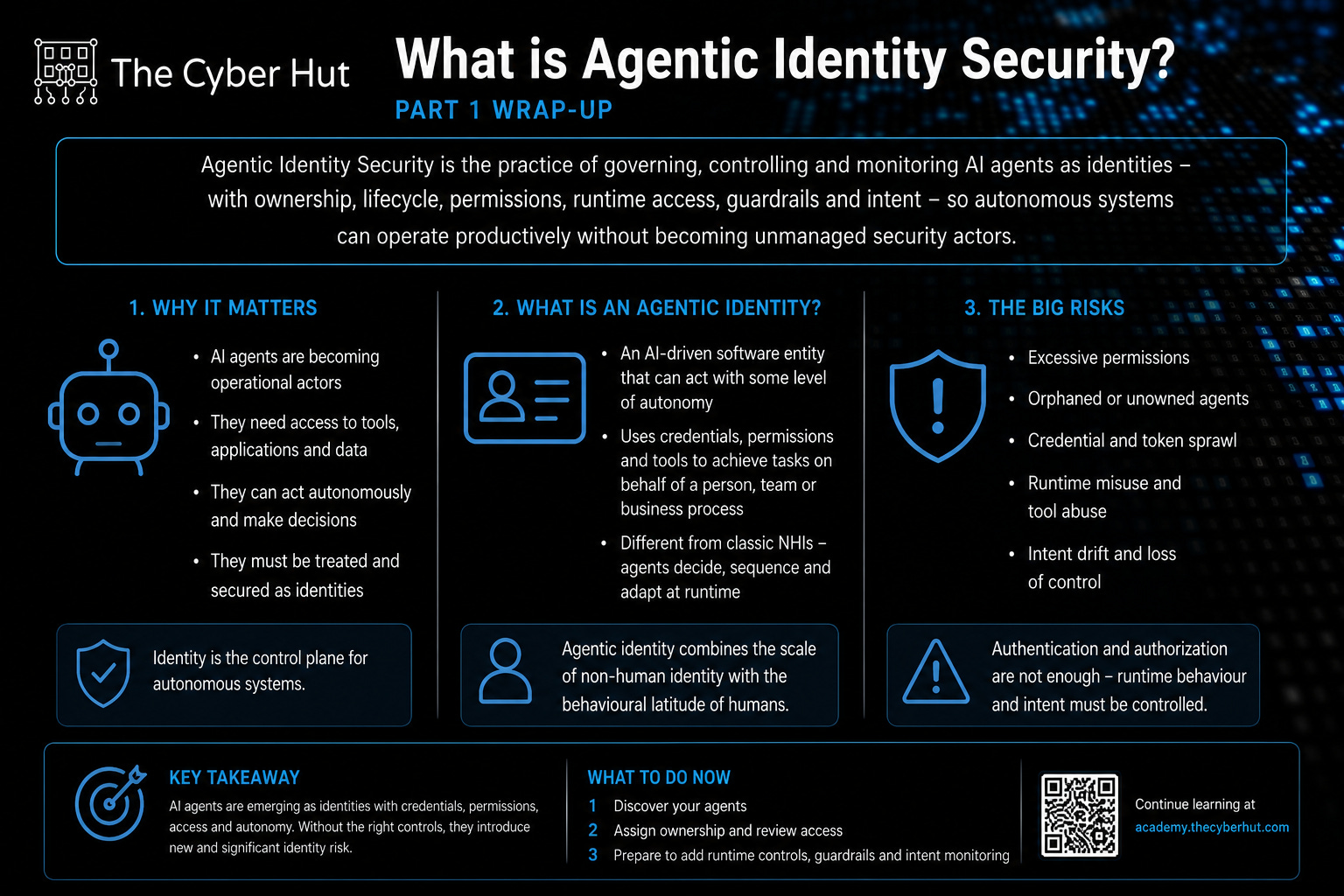
This is taken from The Cyber Hut’s Academy series Episode 41 “What is Agentic Identity Security - Part 1”

The Why
Why has Intent Management become interesting now? Isn’t this just the same as standard behaviour monitoring that we have seen with user entity behaviour analytics (UEBA) or more latterly in concepts like identity threat detection and response (ITDR)?
Yes, and no.
Intent management is a critical mechanism in agentic identity security that focuses on validating the underlying rationale and expected behavioral boundaries of an autonomous AI agent's actions. This generates some subtly new requirements.
Traditional identity security platforms had evaluated whether a user has permission to access an object or resource.
Agents introduce two more subtle issues: a level of autonomy and optimisation. Both of which result in the now commonly used term “non-deterministic” behaviour. Essentially we can’t easily predict what the agent will do. Some of its moves will seem strange - but will be entirely legitimate - some of its moves will seem “OK” but will be entirely malicious. It is also quite likely that access changes, multiple-system usage and a broad array of permissions is entirely likely during the completion of a task. Knowing what to allow, block and monitor is complex.
So we move away from a simple authorization decision + monitor pattern, to something more along the lines of "Yes, they have permission to do something, but why are they doing it now, and is it expected?”.
This layer of security addresses the behavioural reality that autonomous agents do not operate within human social constructs - that of trusted colleagues for example.
Capabilities
Capabilities in this area are both new and evolving rapidly. However, we can frame our thinking about what questions we want to answer. The following is taken from our Academy episode 42 “What is Agentic Identity Security - Part 2” that takes a high level look at the top 6 control areas we need to consider for risk reduction. Part 6 is about observability and intent.
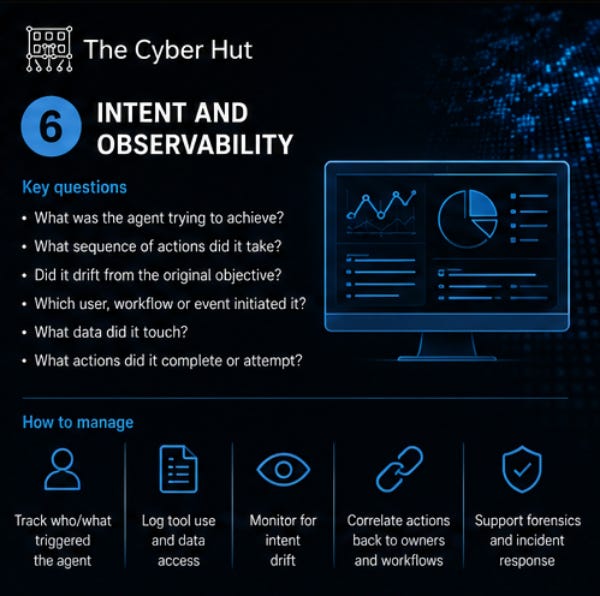
Here we need to look at what agent is trying to do - what has it done before in the current sequence and can we predict a sequence of events going forward? What triggered it and has it been influenced in anyway?
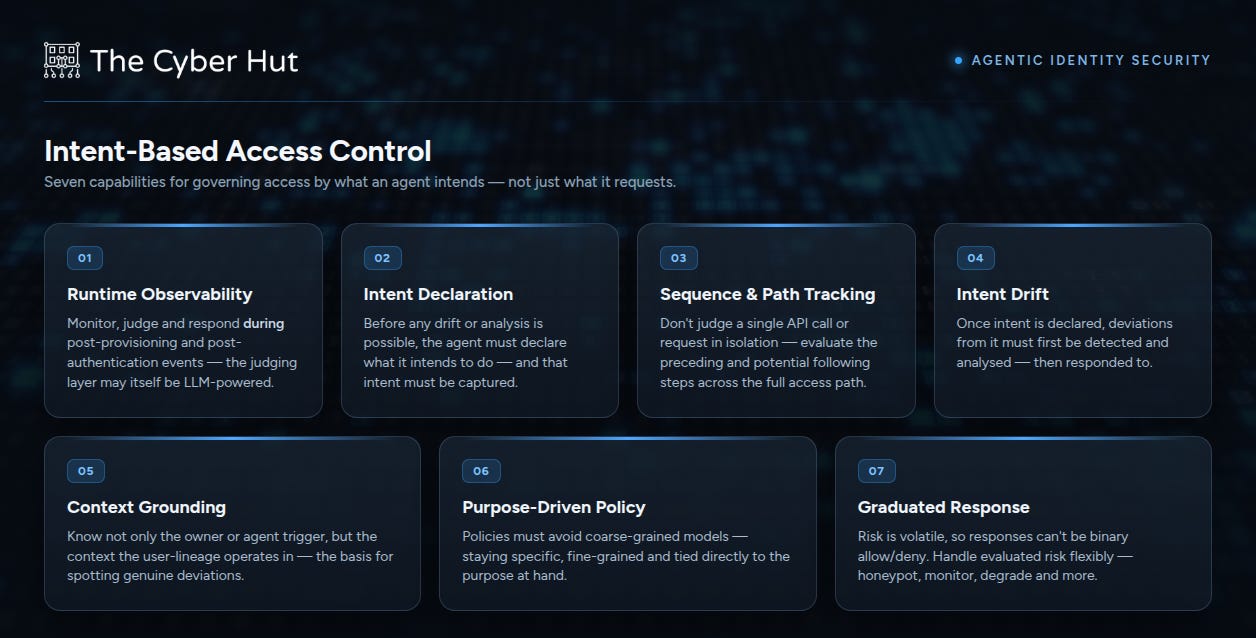
Example capabilities to consider should include:
Runtime observability - being able to both monitor, judge and respond during post-provisioning and post-authentication events - the judging aspect may well be another LLM powered component
Intent declaration - for any drift or analysis steps to take place, the agent must declare that it intends to do - and this needs capturing with integrity protection
Sequence and access path tracking - it’s important not to just analysis the agent during a single API call or access request - but look at before and potentially the after steps in the full access path
Intent drift - once the intent has been declared, deviations from that first need to be analysed and then responded to
Context grounding - an ability to know not only the owner/agent trigger, but also the context the user-lineage operates in to find deviations
Purpose-driven policy - access policies are important, but must not fall into the basic coarse-grained models - they must be specific, fine grained and linked to the purpose at hand
Graduated-response - risk will be volatile and not all responses should be allow/deny - with a flexible way of handling evaluated risk. E.g. honeypot, monitoring, degradation etc
Example Vendor Solutions for Intent Based Access Control & Management
Apono (now part of 1Password)
Apono implements intent-based access control by shifting from static rules to context-aware, just-in-time (JIT) runtime authorization for both human and AI agents. Using the Agent Privilege Guard, it validates declared intentions in real-time, enforcing least-privilege access and automatically revoking permissions to eliminate standing privileges.
Apono positions itself at the intersection of dynamic access control, identity-native security, and modern operations by delivering Zero Standing Privileges (ZSP) and friction-free, Just-in-Time (JIT) access across cloud services, databases, and servers. Moving away from traditional, static vault-centric architectures, the platform manages risk through an iterative lifecycle of discovery, detection, assessment, and policy-driven control. Its core innovation revolves around "Access Flows" and dynamic "access guardrails".
Clevr Security
Clevr Security manages intent specifically for AI agents, copilots, and autonomous workflows through Intent Analysis at the execution boundary. Instead of just analyzing prompts or applying static rules, they evaluate the underlying intent of an agent’s multi-step plan before any action is allowed to run. They describe three main aims:
1. Goal Drift Detection
Multi-Step Tracking: Clevr tracks every step of an agent’s plan against the user’s original instruction.
Off-Script Flags: It catches the exact moment an agent’s goal shifts from what was authorized (e.g., if a task is to “send a report,” but the agent’s plan expands to “query all contacts” and “export to external storage”).
2. Pre-Execution Interception
Context Accumulation: The platform continuously accumulates session state and historical context to weigh the agent’s current action against its stated intent.
Real-Time Intervention: If an action is deemed “out of bounds” or misaligned with the original intent, Clevr intercepts it before it reaches business systems, routing the request to Deny, Modify, or Escalate for human approval.
3. Intent-Driven Policy Enforcement
Live System Checks: It maps the agent’s intent against real-time business parameters like change windows, budget caps, data sensitivity, and segregation of duties.
AARM Compliance: Clevr aligns its intent validation with the AI Agent Runtime Security (AARM) open standard, specifically fulfilling requirements for pre-execution evaluation and identity-to-intent binding.
Kontext Security
Kontext addresses intent-management within its runtime authorization framework by treating intent as a core variable to compare requested actions with authorized tasks. Rather than relying solely on credentials or token presence, the system evaluates the underlying reason for an action to protect against vulnerabilities like prompt injection and excessive agency. Kontext structures and manages intent include:
1. Interception at the Action Boundary
Kontext positions its runtime policy checks immediately preceding tool invocation, API execution, or data access. Intercepting actions at this boundary ensures that a model’s generated plan can be analyzed before any external side effects occur.
2. Processing Structured Intent Context
The authorization system processes an explicit JSON payload detailing the runtime intent. Key evaluation variables include:
Declared Task: The specific task the agent is trying to complete.
Source: The origin of the instruction (e.g., user prompt vs. third-party data inputs).
Confidence Scores: Structural context determining how confidently the intent matches authorized workflows.
Session History: Context chains that look at prior tools called and data accessed to catch drift or multi-hop data exfiltration paths.
3. Mitigating Malicious Purpose Mapping
Kontext uses intent data to differentiate between identical API calls carrying vastly different risk profiles. For example, a policy can evaluate the task intent to allow a standard tool read parameter while simultaneously blocking a bulk export triggered by an indirect prompt injection payload.
4. Auditable Evidence Generation
Intent classification functions as a required log parameter for framework compliance, such as the NIST AI Risk Management Framework (AI RMF). Kontext logs the classified intent alongside the specific user delegation path, agent identity, parameters, and matching policy version to generate an immutable, reviewable audit trail.
Oasis Security
Oasis Security manages intent through a capability called Agentic Intent & Access Control, which is a core component of its Agentic Access Management (AAM) platform. Rather than relying on traditional, rigid static roles and permissions, Oasis focuses on understanding why an AI agent is requesting access before granting it.
This can be described in three main areas:
1. Intent-Aware Access Decisions
Context Over Permissions: The platform actively analyzes the real-time context of what each non-human identity or AI agent is doing and why.
Dynamic Approval: Instead of granting permanent privileges, access control decisions are tightly bound to the agent’s specific, declared intent at that moment.
2. Time-Bound Governance
Automated Provisioning: Oasis automatically maps and provisions the specific permissions an agent needs to execute its task.
Time Restrictions: Access is strictly time-bound. The moment the agent’s intent is fulfilled or the allowed window expires, the access is automatically restricted or removed to prevent over-privileged standing access.
3. Comprehensive Ecosystem Integration
Cross-Environment Tracking: Oasis tracks agentic intent across a wide hybrid footprint, including cloud providers (AWS, Azure, GCP), development hubs (GitHub), data ecosystems (Snowflake, BigQuery), and AI endpoints (ChatGPT, Copilot, Bedrock).
Inventory & Visibility: It creates a real-time inventory that ties every active AI agent identity back to a clear human owner or core internal system, ensuring that intent can always be traced back to an accountable source.
PlainID
PlainID addresses intent management through its recently launched Agentic Identity Platform, which utilizes Intent-Based Access Control (IBAC) to secure AI agents, Retrieval-Augmented Generation (RAG) systems, and Model Context Protocol (MCP) tool flows.
1. Intent-Based Access Control (IBAC)
Moving Past Static Roles: PlainID shifts authorization away from rigid user roles to dynamically evaluate what an AI agent intends to execute in real time.
End-to-End AI Boundaries: It defines and enforces clear guardrails across the entire AI session lifecycle to dictate what an agentic identity can safely access, modify, or expose.
2. Runtime Authorization & Zero Standing Privileges
Dynamic Decision Engine: Every intent is intercepted and parsed by a smart decision engine that applies fine-grained precision and context to the request.
Just-In-Time Rules: Instead of allowing persistent background data access, permissions are granted dynamically for the specific task at hand, enforcing Zero Standing Privileges across connected apps and databases.
3. Policy-Based Access Control (PBAC) Standardization
Unified Policy Language: PlainID allows organizations to write an authorization policy once and distribute it everywhere across SaaS apps, APIs, microservices, and AI models.
Integration Hub: It embeds directly into AI frameworks (like LangChain) to evaluate intent natively before the agent calls an external data platform or internal service.
4. Agentic AI Observability
Auditable Intent Traces: The platform logs every agent action, intent evaluation, and authorization decision into clear, business-readable language.
Compliance & Governance: Security teams and auditors can track exactly why a bot requested a specific tool execution and how the policy reacted to it.
Reva
Reva.AI brands itself as the industry’s first Intent & Behavior Based Access Control (IBAC) platform. They treat intent not just as a buzzword, but as the strict “semantic backbone” of least-privilege authorization for autonomous AI agents.
According to their technical framework, Reva.AI implements intent-based access control through the following core technical mechanisms:
1. The Core Paradigm Shift: “Actions to Intents”
Traditional access control answers who can invoke an API. Reva’s IBAC shifts the entire authorization question to: “For the current task and context, is this specific action over these resources allowed?” It decouples security from static roles and maps access directly to a defined purpose.
2. The 5-Step Runtime Enforcement Architecture
Reva maps out a concrete technical pipeline that executes at machine speed before an agent can cause damage:
Step 1: Intent Templates: Organizations define canonical, YAML-style templates for workflows (e.g.,
patch_production_service). These explicitly specify allowed actions, resources, and hard constraints (like max lines edited or database rows read).Step 2: Parsing Natural Language: A classifier or small LLM maps a user’s natural language instruction into one of these strict template formats.
Step 3: Fine-Grained (FGA) Mapping: Reva’s platform acts as a “policy generator,” translating that approved intent into standard Fine-Grained Authorization (FGA) tuples (e.g.,
agent:read#table:finance_2025).Step 4: Cryptographic Intent Tokens: At the start of a session, Reva binds these allowed tuples and constraints into a highly temporary, signed JWT token.
Step 5: Gateway Interception: The Reva Trust Gateway checks every single tool or Model Context Protocol (MCP) call against the token. If the agent tries to wander off-script—even due to prompt injection or model hallucination—the gateway hard-blocks the tool execution before it hits production systems.
3. Domain-Specific Ontologies
Instead of generic guardrails, Reva structures intent around a domain-specific vocabulary mapping Users/Agents, Tasks, Actions, Resources, and Constraints. This enables highly contextual rules, such as allowing a healthcare agent to read patient labs for a “clinical review” task, but automatically denying the action if the agent attempts to mass-export the data.
4. Built on Open Standards
Rather than forcing proprietary lock-in, Reva applies its intent management layer on top of industry-standard policy languages and engines like Cedar, OPA (Open Policy Agent), OpenFGA, and AuthZEN.
Silverfort
Silverforts’s recent acquisition of Fabrix adds further agentic-centric decision capabilities to their existing ITDR plans.
They address intent management by treating AI agents as dynamic, non-human identities and applying identity-first runtime protection to control their actions. Rather than allowing an agent to wander “off-script,” Silverfort mitigates behavioral drift and malicious intent by intercepting unauthorized tool and access requests before they execute.
They handle intent and runtime security through several key capabilities:
1. Stopping Behavioral Drift and Misguided Intent
Detecting Deviant Behavior: Silverfort continuously monitors agent sessions for internal risks, specifically focusing on “behavioral drift”- instances where an autonomous agent acts outside its original intent or designated scope.
Blocking Attack Delegation: It detects and blocks prohibited agent-to-agent delegation chains, ensuring an agent cannot pass instructions or privileges to another bot to bypass restrictions.
Defending Against Malicious Override: Its runtime layer stops external, adversarial intents like prompt injections or poisoned Model Context Protocol (MCP) servers from hijacking the agent’s logic.
2. Dual-Architecture Runtime Enforcement
Silverfort ensures that regardless of an agent’s intended action, it must clear a hard identity policy boundary via two enforcement methods:
MCP Gateway (Universal Inline Security): For custom or open-framework agents using the Model Context Protocol, Silverfort routes traffic through an inline MCP Gateway. It evaluates the agent’s identity and policy in real time, intercepting unauthorized tool calls before they hit internal data servers.
Native Platform Integrations: For cloud-managed ecosystems (like Microsoft Copilot Studio or Google Cloud Agent Gateway), Silverfort embeds directly into the platform’s control plane to block actions without requiring separate traffic routing.
3. Least-Privilege Identity Binding
Context-Aware Decisions: Every access request is evaluated against a centralized policy defined by the agent’s identity, the user context, the target application, and the specific action type.
Eliminating Over-Privileged Access: By continuously mapping agents to clear human owners and auditing their exact blast radius, Silverfort ensures agents do not possess standing privileges that exceed their day-to-day administrative intent.
Teleport
Teleport recently released an Agentic Identity Framework - covering a broad array of use cases to protect the agentic life cycle and runtime access.
The framework manages intent by enforcing strict cryptographic bindings and infrastructure boundaries, rather than interpreting natural language. It secures agentic intent through "Identity-to-Intent" binding, delegated authorization, dynamic ABAC, and granular auditing of tool execution.
Teleport defines Identity-Intent Binding through a zero-trust, infrastructure-first approach that treats AI agents as distinct, authenticated workloads rather than relying on reactive text-based analysis. Their strategy utilizes ephemeral, hardware-isolated runtimes and short-lived cryptographic certificates to enforce strict, "steady-state" computing where agent access is bound to specific, time-limited tasks.
Recommendations
The rise of agentic AI strips away a fundamental assumption that identity security has relied on for decades: predictability. When autonomous, non-deterministic agents are given the keys to enterprise data ecosystems, static roles and traditional privilege monitoring are no longer enough to prevent catastrophic drift or malicious exploitation. Security can no longer safely operate on an “allow or deny” permission structure when an agent’s technical access looks perfectly legitimate on paper but deviates entirely from its actual business task.
Intent-Based Access Control (IBAC) represents the necessary evolution of zero-trust architecture for the AI era. By forcing agents to declare their goals, tracking their multi-step execution paths, and binding identity directly to an authorized purpose in real-time, security teams can safely govern systems without choking innovation.
To prepare enterprise infrastructure for non-deterministic workloads, identity and security architects must transition from static access management to dynamic runtime controls.
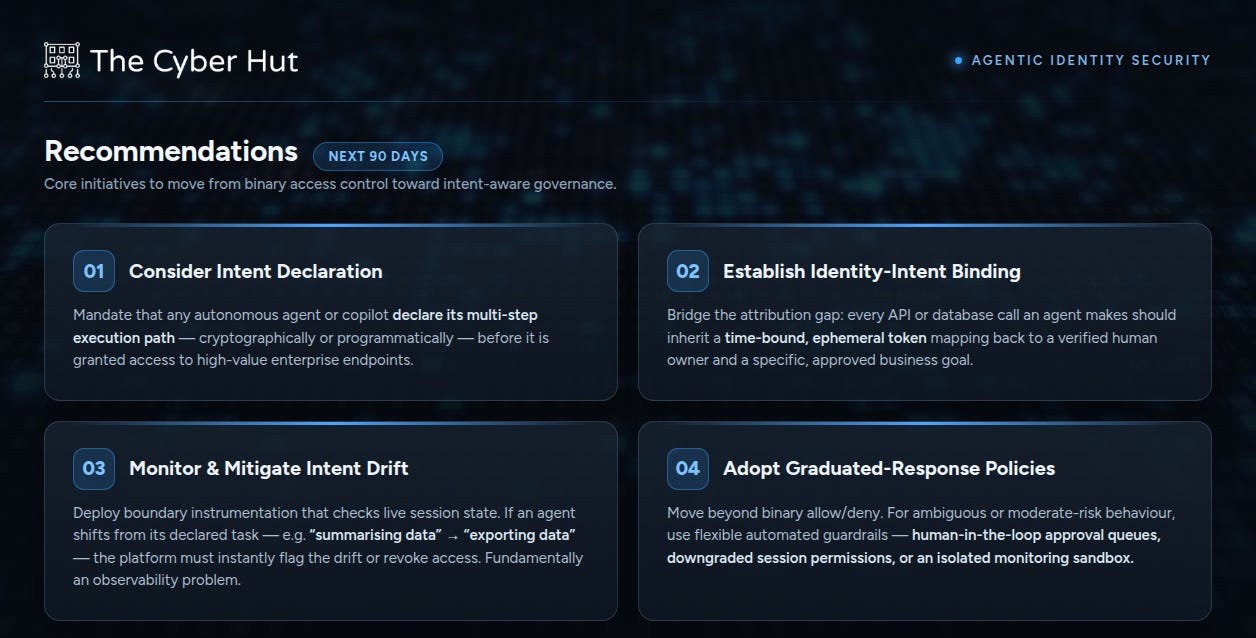
Some core initiatives to consider over the next 90 days:
Consider Intent Declaration: Mandate that any autonomous agent or copilot must cryptographically or programmatically declare its multi-step execution path before it is granted access to high-value enterprise endpoints.
Establish Identity-Intent Binding: Bridge the attribution gap by ensuring every API or database call initiated by an agent inherits a time-bound, ephemeral token that explicitly maps back to a verified human owner and a specific, approved business goal.
Monitor and Mitigate Intent Drift: Deploy boundary instrumentation capable of checking the state of a live session. If an agent shifts from its declared task (e.g., changing a task from “summarising data” to “exporting data”), the platform must instantly flag the drift or automatically revoke access - essentially an observability problem.
Adopt Graduated-Response Policies: Move away from binary “allow/deny” logic. For ambiguous or moderate-risk agent behaviour, implement flexible, automated guardrails such as routing requests to a human-in-the-loop approval queue, downgrading session permissions, or steering the agent into an isolated monitoring sandbox.
About The Author
Simon Moffatt has over 25 years of experience in IAM, cyber, and identity security. He is the founder of The Cyber Hut, a specialist research and advisory firm based out of the UK. He is the author of CIAM Design Fundamentals and IAM at 2035: A Future Guide to Identity Security. He is a Fellow of the Chartered Institute of Information Security, a regular keynote speaker, and a strategic advisor to entities in the public and private sectors.
Last updated 29 June 2026.