

The Hidden Risk of Fragmented Identity
And what can be done about it

As organisations scale across cloud, SaaS, and AI-driven environments, identity has become the primary control plane for security and access. Yet most enterprises still operate with a fragmented identity architecture—multiple tools, disconnected policies, and incomplete visibility.
This fragmentation is no longer just inefficient—it is a fundamental business and security risk.
The Problem: Identity Fragmentation at Scale
Modern enterprises manage a rapidly expanding set of identities:
employees and contractors
service accounts and APIs
cloud workloads and automation
emerging AI agents
However, these identities are typically governed by multiple IAM systems operating in silos, often 6–16 different tools in a single organisation.
This creates a fragmented environment where:
visibility is partial
policies are inconsistently enforced
identity relationships are poorly understood
The result is an incomplete and unreliable view of access and risk.
What Can Be Done: Migration to Unified Identity
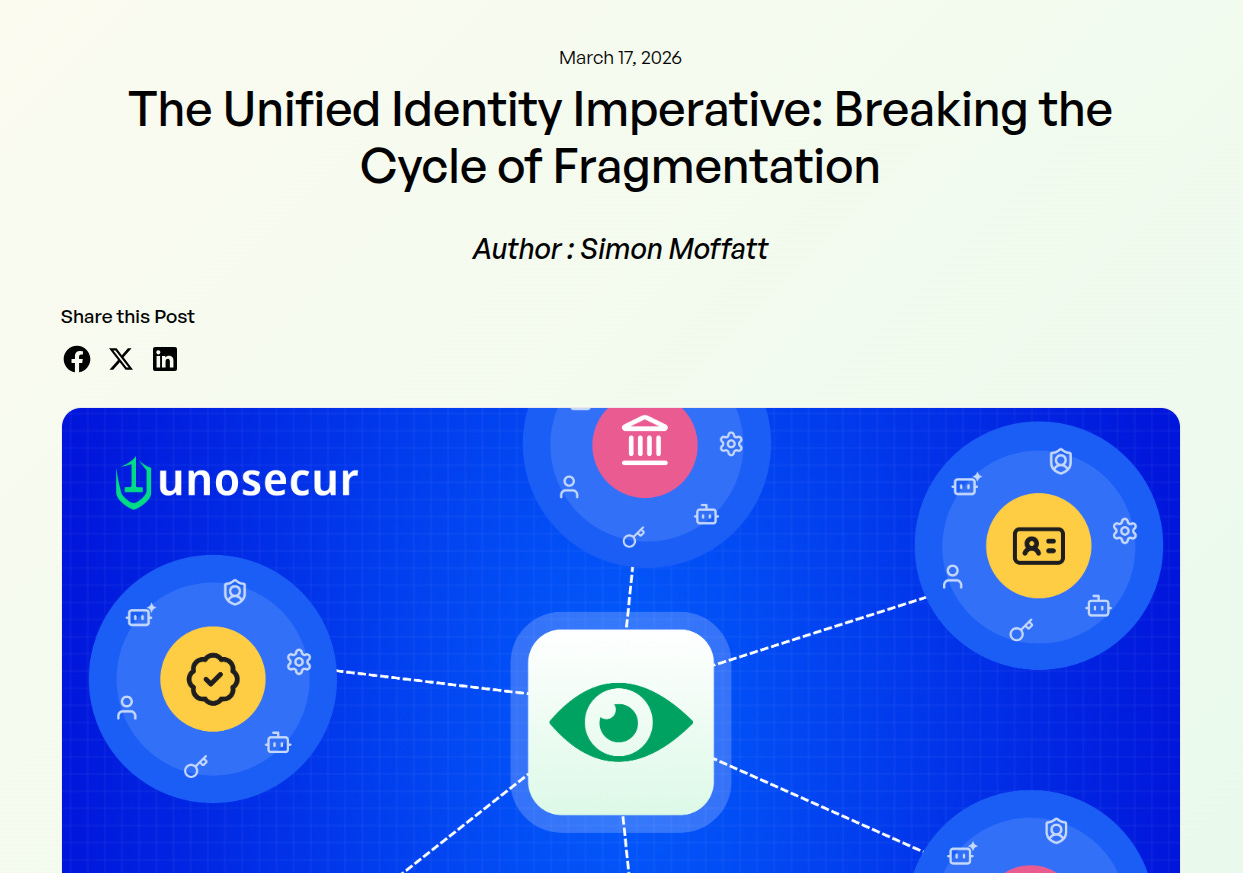
The core need is for a unified identity model, often described as an “identity mesh.”
This approach connects all identity systems—legacy, cloud, SaaS—into a single, orchestrated layer.
Key characteristics include:
1. Centralised visibility
A complete inventory of all identities (human and non-human)
Clear mapping of permissions and relationships
2. Consistent policy enforcement
Unified access controls across all environments
Standardised authentication and governance
3. Continuous monitoring
Real-time tracking of identity behaviour
Detection of anomalies and misuse
4. Lifecycle orchestration
Integrated joiner–mover–leaver processes
Automated provisioning and deprovisioning
These concepts are part of an analyst comment series written for Unosecur. The first article is available to read now.
About The Author
Simon Moffatt has over 25 years of experience in IAM, cyber, and identity security. He is the founder of The Cyber Hut, a specialist research and advisory firm based out of the UK. He is the author of CIAM Design Fundamentals and IAM at 2035: A Future Guide to Identity Security. He is a Fellow of the Chartered Institute of Information Security, a regular keynote speaker, and a strategic advisor to entities in the public and private sectors.